Psychological safety has become one of the most important expectations in modern WHS practice. Yet for many employers, the term feels vague — a buzzword without a clear operational meaning.
In reality, psychological safety is now a compliance requirement, a cultural foundation, and one of the most powerful ways organisations can improve engagement, retention and performance, particularly for young male employees.
We break down what psychological safety actually is and share some of the warning signs we’ve seen through our work with businesses and organisations.
What psychological safety really means
A psychologically safe workplace is one where employees feel able to:
- Speak openly about concerns or pressures
- Ask questions or admit mistakes without fear of judgement
- Seek support early, before issues escalate
- Offer ideas or feedback
- Participate in problem-solving without worrying about being shut down
This is not about lowering standards. It is about creating a culture where employees can perform at their best because they feel safe, respected and supported.
Safe Work Australia recognises that poor communication, unclear expectations, interpersonal conflict, high job demands and low support are all psychosocial hazards employers must identify and control under WHS law.
Young workers experience these hazards at the highest rates.
Why does this matter for young male employees
Research shows that 75% of mental health issues emerge before age 24 . Young men entering the workforce are in a high-pressure transition defined by:
- new responsibilities
- heavy performance expectations
- limited workplace experience
- desire to prove themselves
- uncertainty about identity, belonging and capability
Many also internalise masculine norms such as “don’t show weakness” or “figure it out on your own”, which makes help-seeking even less likely.
The result? Young male workers often stay silent even when they are overwhelmed, confused or struggling.
Managers misinterpret this silence as a lack of engagement, poor attitude or entitlement.
Psychological safety closes this gap. When young men feel safe to ask questions or express uncertainty, the risks of burnout, conflict and disengagement drop dramatically.
Early warning signs your workplace may not feel psychologically safe
Across our research, conversations with employers and our work with young men, several patterns emerged :
1. Silence in meetings and check-ins
Young staff contribute less, ask fewer questions and rarely raise concerns.
2. Working long hours without pushing back
Many young men described “sink or swim” environments, unpaid overtime and pressure to always be available — but felt unable to speak up.
3. Reluctance to ask for help
Driven by fear of judgement or masculine norms around independence.
4. Bottling up stress until it affects performance
Managers see sudden dips in behaviour or output and young men report months of silent overwhelm.
5. Tension, blame-shifting or withdrawn behaviour
This often indicates fear of making mistakes or unclear expectations.
These behaviours are incorrectly labelled as “poor communication”, when in reality they are indicators of low psychological safety and high psychosocial risk.
The business case: Why psychological safety is a performance strategy
Psychological safety is not only good practice. It’s a measurable business advantage. Evidence shows that mentally healthy workplaces experience:
- Higher engagement and job satisfaction
- Reduced absenteeism and presenteeism
- Lower turnover
- Stronger workplace relationships and communication
- Improved productivity and team performance
For organisations with young workforces – trades, tech, hospitality, manufacturing, logistics – the impact is even more significant. Young workers are at greater risk of workplace harm, job strain and bullying, making early cultural intervention essential.
A psychologically safe culture is not a “nice to have”; it is a WHS imperative and a strategic asset.
Are you ready to strengthen your workplace?
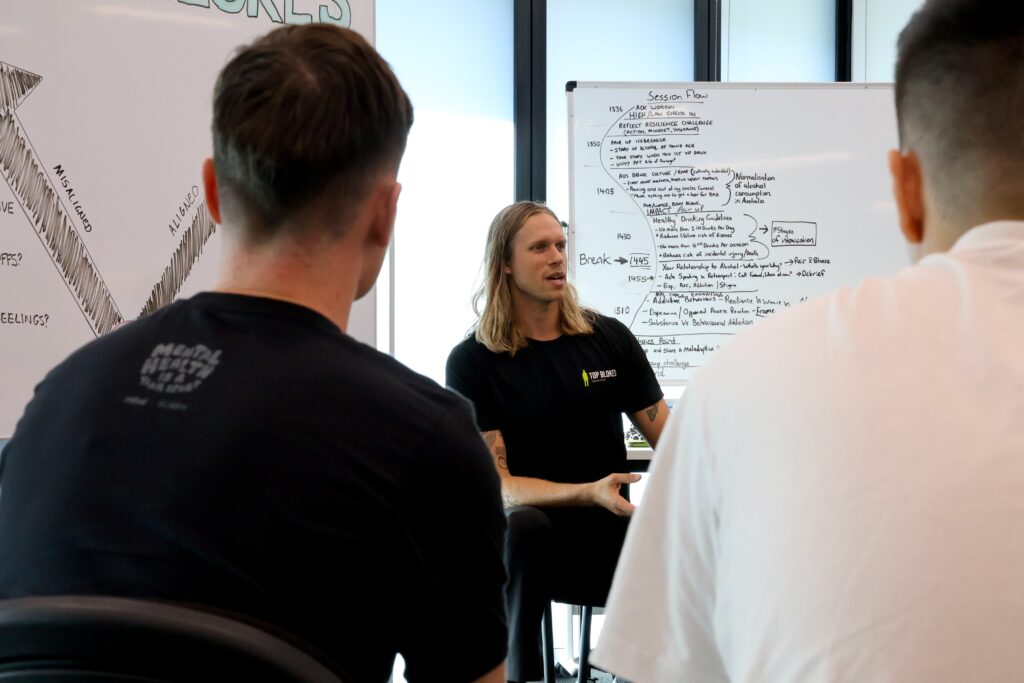
Top Blokes delivers evidence-based mentoring programs that help young male employees build resilience, communication skills and confidence – while helping employers meet psychosocial safety obligations. Book a free discovery call to discuss how we can support and upskill your young male employees.