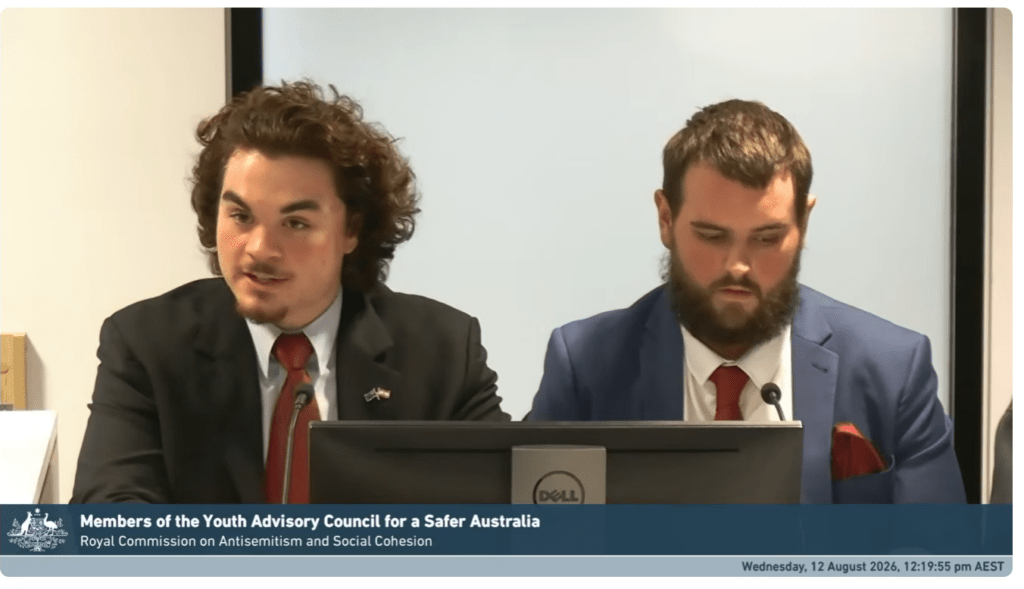
At the Royal Commission on Antisemitism and Social Cohesion, two Top Blokes set out what radicalisation really looks like for young men today, and what an effective response requires.
Antisemitism, radicalisation and extremism are usually discussed in the abstract – as ideologies, as threats, as things to be countered. What’s harder to find is a clear-eyed account of how an ordinary teenage boy actually ends up somewhere harmful, and what stops him getting there.
That’s what the Royal Commission on Antisemitism and Social Cohesion heard from Hayden and Salim, two youth advocates who both came through Top Blokes as teenagers. Salim now co-chairs the Australian Government’s Youth Advisory Council for a Safer Australia and has been a Top Blokes Youth Ambassador, and Hayden joined Top Blokes as a trainee Youth Worker and now works for Top Blokes mentoring young men. Their evidence didn’t focus on ideology. It focused on connection, critical thinking and the everyday conditions that leave a young man vulnerable in the first place.
Understanding what sits underneath harmful behaviour
The Royal Commission’s hearings examined the drivers of antisemitism and radicalisation, including the role of online environments and how early intervention and community-based responses can prevent extremism.
For Hayden and Salim, the conversation came back repeatedly to something Top Blokes sees every day: Connection matters.
Hayden spoke about social isolation, disconnection and loneliness and what can happen when those experiences combine with hours spent online.
An isolated young person can find themselves inside an echo chamber, he explained, where algorithms continually serve content that reinforces the same ideas and makes it increasingly difficult to step outside them.
Salim was equally careful not to oversimplify the issue. Poor mental health doesn’t make somebody an extremist, he stressed. But depression and other mental health challenges can contribute to isolation, loneliness and disconnection creating vulnerabilities that harmful communities and ideologies may exploit.
It’s an important distinction. Understanding vulnerability is not the same as excusing hatred.
Hate speech, racism and extremist behaviour have to be challenged. But if we want to prevent them rather than simply respond once the damage has been done, we also have to understand how a young person got there.
When does a joke stop being a joke?
The Commission had received confronting evidence about antisemitic remarks made by children, including content that trivialised historical atrocities.
Hayden pointed to a question the Top Blokes uses with young people, one that speaks to the same underlying problem: Are those jokes starting to not feel like jokes anymore?
He said many young people don’t necessarily have the knowledge or critical-thinking skills to recognise when something has crossed a line. It’s a gap that can show up well before it ever reaches the kind of behaviour the Commission was examining.
To illustrate what that gap looks like in practice, Hayden shared a separate example from his own program, from only days earlier. This wasn’t an antisemitic incident, but a moment where a boy’s behaviour was, in Hayden’s words, “teetering on that line.”
Rather than immediately deciding what the behaviour said about the boy, Hayden had a conversation with him.
Hayden was clear that he didn’t believe this young person was heading towards radicalisation. What he saw instead was a lack of understanding about the seriousness of what was being said, alongside gaps in critical thinking and empathy towards other groups.
That doesn’t make the behaviour acceptable. But it does change what an effective response looks like, and it shows the response working: a young person’s thinking gets challenged and redirected long before it becomes entrenched.
The intervention a young person needs isn’t another person telling them they are bad.
It’s someone they trust asking:
What do you mean by that?
Where did you hear it?
Why do you think it’s funny?
Who could that hurt?
Have you thought about what you’re actually saying?
Those conversations create an opportunity to challenge harmful ideas before they become entrenched.
Young men aren’t necessarily looking for extremism
It’s a message Top Blokes has taken to government before.
In February 2026, Top Blokes appeared before the NSW Parliamentary Inquiry into Measures to Combat Right-Wing Extremism, with Hayden and our Founder Melissa Abu-Gazaleh giving evidence alongside our written submission.
Our message was simple: many young men aren’t going online looking for extremism.
They’re looking for humour. Entertainment. Gaming. Community. Answers about relationships, masculinity and identity. Most of all, they’re looking for somewhere to belong.
But online systems can take them somewhere they never intended to go.
Top Blokes told the inquiry that exposure can be gradual: polarising material can be mixed with humour, banter, misogyny and content about masculinity or identity, progressively shaping the way a young person views themselves and others.
Hayden’s evidence helped draw attention to the automatic nature of harmful online exposure and to the need to see radicalisation not only as a law-enforcement problem, but as something that can develop gradually through relationships, isolation and online environments.
The inquiry’s final report picked up on these themes, emphasising belonging, critical thinking, community programs and preventative education as part of the response.
Now, sitting before the Royal Commission, those same lessons were being applied to an even broader national conversation about antisemitism, hate and social cohesion.
Speak with young men, not at them
For Salim, one principle sits at the centre of the solution. Young people need to be spoken with, not spoken at.
He told the Commission that “conversation rather than confrontation” can take us much further when engaging a young person.
And when talking specifically about young men who may be influenced by harmful online communities, Salim made another important point: don’t demonise the young men themselves.
Engage them. Challenge them. But keep the conversation open.
Later, he described the starting point even more simply: meet young people where they are and approach the conversation with curiosity rather than confrontation.
That philosophy sits at the heart of Top Blokes.
Our youth workers don’t walk into a room assuming they have all the answers. They build relationships first.
They listen. They ask questions. They create a space where boys can talk honestly about masculinity, mental health, relationships, what they’re watching online, what their mates are saying and what they’re trying to figure out about themselves.
Then they help young men question what they are seeing and hearing. Critical thinking isn’t built by telling someone what to think.
It’s built by teaching them how to think.
What does this mean for prevention?
Strip away the individual anecdotes and a consistent picture emerges.
Radicalisation among young men is rarely about ideology first. It’s about isolation, disconnection and a lack of critical thinking, met by online systems that are very good at exploiting exactly those gaps.
The response, then, isn’t primarily a law-enforcement one. It’s relational and preventative:
- Give a young man somewhere to belong.
- Give him trusted people who will listen and challenge him, rather than lecture or demonise him.
- Give him the skills to question what he sees and hears, before those ideas have a chance to harden into a worldview.
That’s the case Hayden and Salim put to the Commission.
The real impact of Top Blokes isn’t only what happens while a young person is in the room. It’s what they carry forward. Hayden and Salim both came through Top Blokes, and we couldn’t be prouder to see them using their voice at this level.
Young men have a lot to say about the issues affecting their lives. Our role should be to listen, learn, and make sure those voices are heard in the places where decisions are made.